
Shopify app discovery is noisy in a very specific way.
The first signals are obvious: review count, rating, brand familiarity, and the Built for Shopify badge. Those signals matter. They also create a blind spot.
A new app with a clear merchant problem can sit under the ranking surface for a long time. A small tool can be useful before it is popular. A listing can be worth checking before it has enough public reviews to feel safe. Most discovery systems are not built for that moment.
That is why I made NBFS.
NBFS stands for the thing it tracks: Not BFS. Yet. It is an independent Shopify app discovery and evaluation surface for apps that do not currently have the Built for Shopify badge, but do have public listing facts worth looking at.
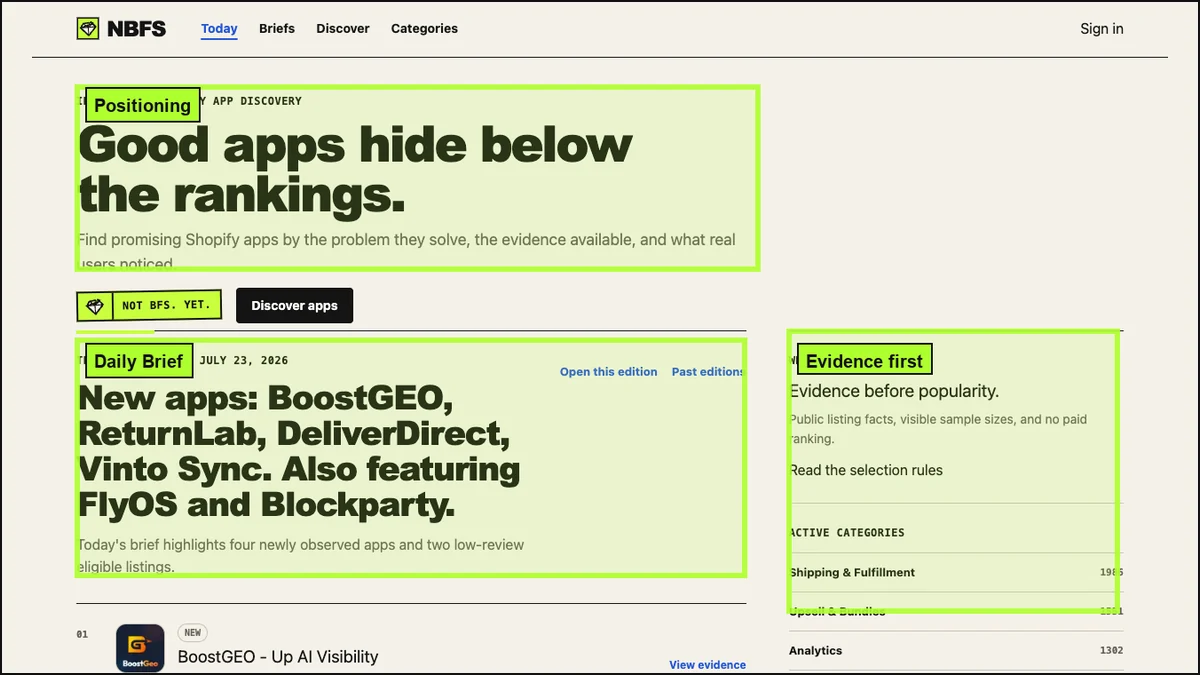
The rule: evidence before popularity
NBFS is not trying to replace the Shopify App Store. It is not a certification system, and a listing on NBFS is not a recommendation.
The job is narrower: collect public facts, separate them from opinion, and make the under-ranked part of the app store easier to inspect.
An app has to be publicly installable on the official Shopify App Store. It has to be non-Built-for-Shopify at the time NBFS checks it. It has to explain a clear merchant problem and expose enough verifiable listing facts to be useful.
Spam, clones, misleading listings, abandoned apps, platform-owned apps, and already established large apps are not the point of the current discovery lane.
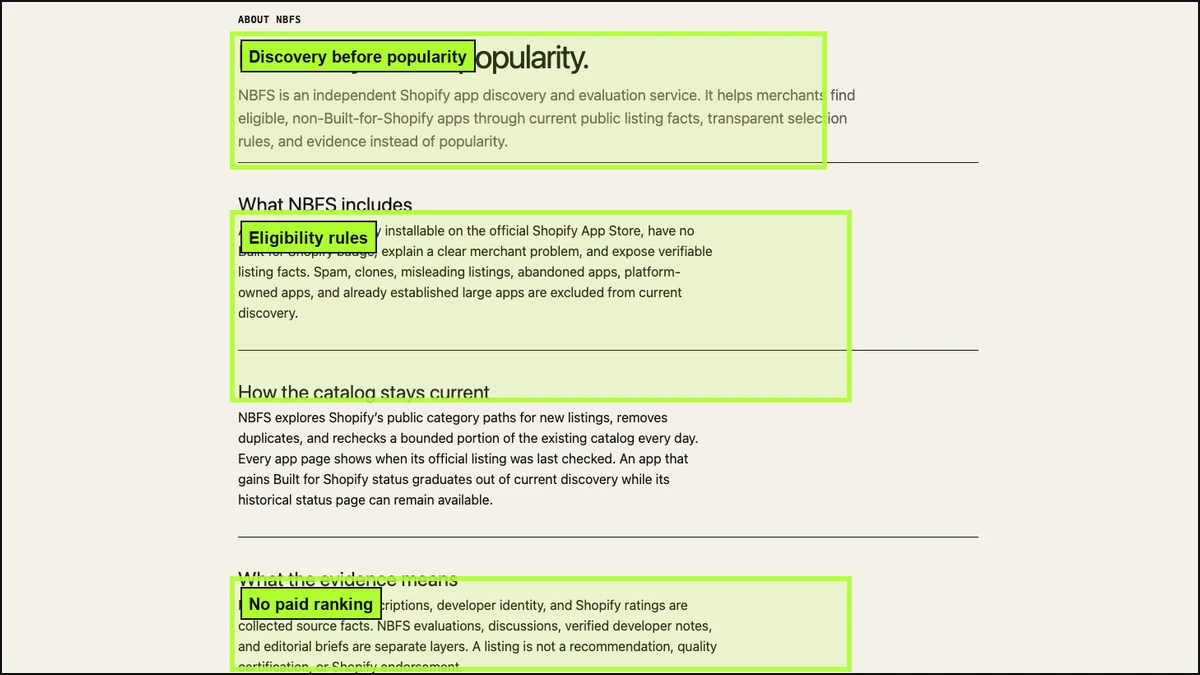
The reason for this boundary is simple: popularity is useful, but it should not be the only sorting layer. Sometimes low review volume means risk. Sometimes it means the app is early. NBFS exists for the second look.
What NBFS collects
The site starts with source facts:
- pricing
- categories
- public descriptions
- developer identity
- Shopify rating state
- official listing screenshots
- first seen and last checked dates
Those facts stay separate from the later layers: NBFS editorial briefs, user evaluations, discussions, and verified developer notes.
That separation matters. It keeps the product from turning into a hype board. The first question is not “is this app good?” The first question is “what can we verify from the public listing?”
Daily Briefs as snapshots
The homepage includes a Daily Brief. Each edition is a persisted editorial snapshot, not just a feed that disappears.
On the current issue I checked, the brief included four newly observed apps and two low-review eligible listings. The copy is AI-assisted from public listing facts, but the model does not choose, add, remove, reorder, or rank the candidates. Application code controls the candidate set and validates the output.
That is the editorial boundary I wanted: models can help turn stored evidence into readable text, but they should not quietly invent the discovery result.
Discover is the main work surface
The Discover page is where NBFS becomes useful as a tool.
At launch, it surfaces more than 19,000 eligible Not BFS apps. You can search by app name, merchant problem, or category, then filter by category, price, status, and sort order.
The important part is the line under the title: Popularity never changes the order.
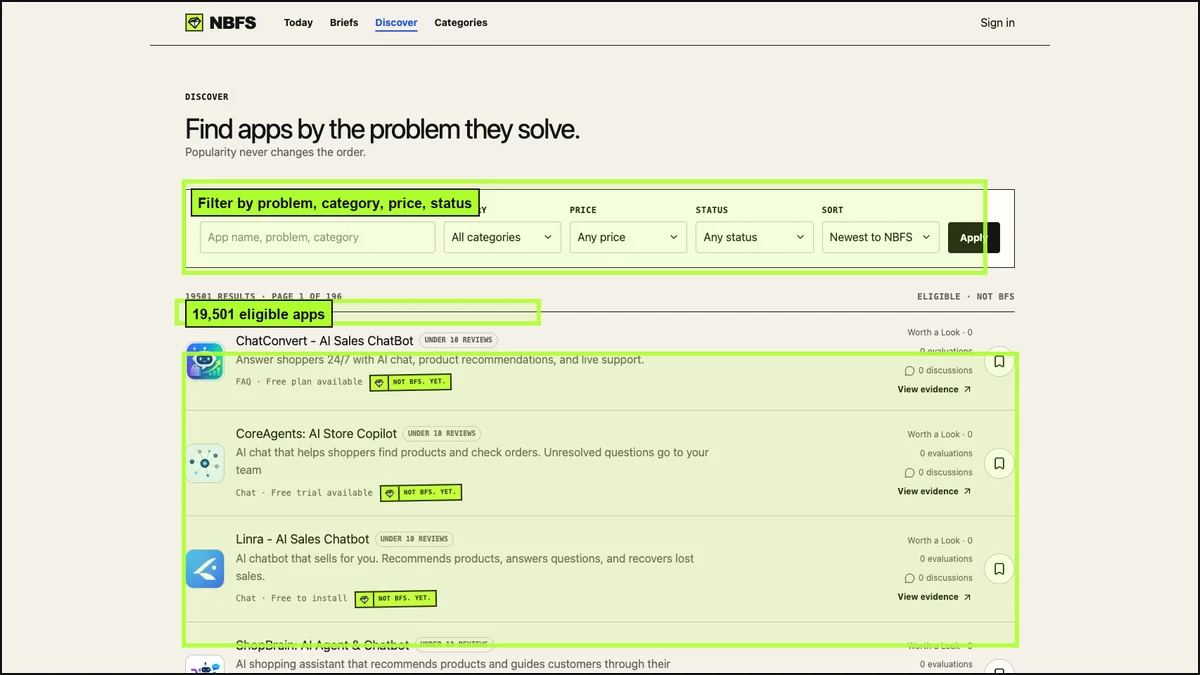
Cards are intentionally plain. They show the app name, visible sample-size signals such as “under 10 reviews,” the public listing summary, category, pricing, NBFS status, evaluation count, discussion count, and a link to view the evidence.
It is not optimized to make the most famous app look inevitable. It is optimized to make the problem space scannable.
App pages are evidence surfaces
Each app has a detail page. That page is where the source facts, current NBFS status, and contribution layers meet.
For example, an app page shows whether the app is eligible and Not BFS, when NBFS first saw it, when the listing was last checked, what the official listing says, what categories and pricing were collected, and who the developer is.
The signature artifact is the embeddable NBFS badge. It is small on purpose: a status mark that links back to NBFS, not a paid placement or universal score.

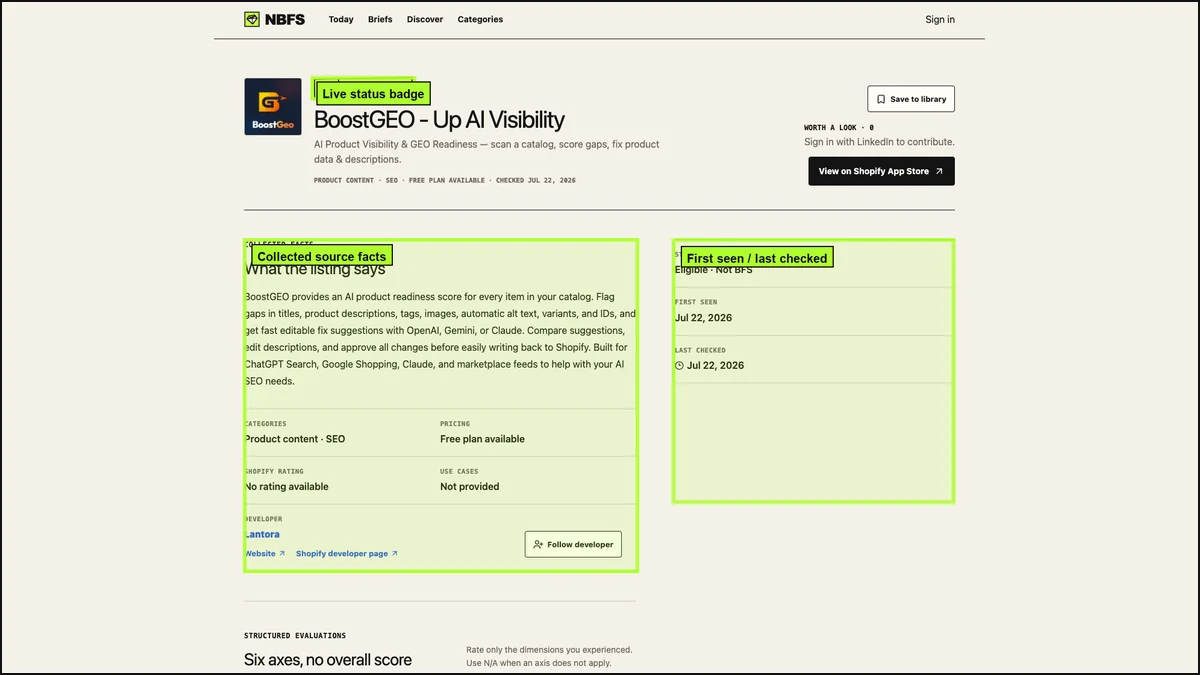
The evaluation model also avoids a single overall score. If someone has used the app, they can evaluate only the dimensions they experienced:
- Setup & Ease of Use
- UX/UI
- Listing Accuracy
- Reliability & Performance
- Support
- Value for Money
A single number would flatten too much. An app can be easy to install but weak on support. Another can be rough in the interface but accurate in the listing. NBFS should preserve those differences instead of compressing them into a badge.
Field Notes only publish when there is enough signal
Weekly Field Notes are intentionally not forced.
The first issue is still gathering evidence. NBFS will only publish a weekly observation when there are at least three distinct source-backed signals available.
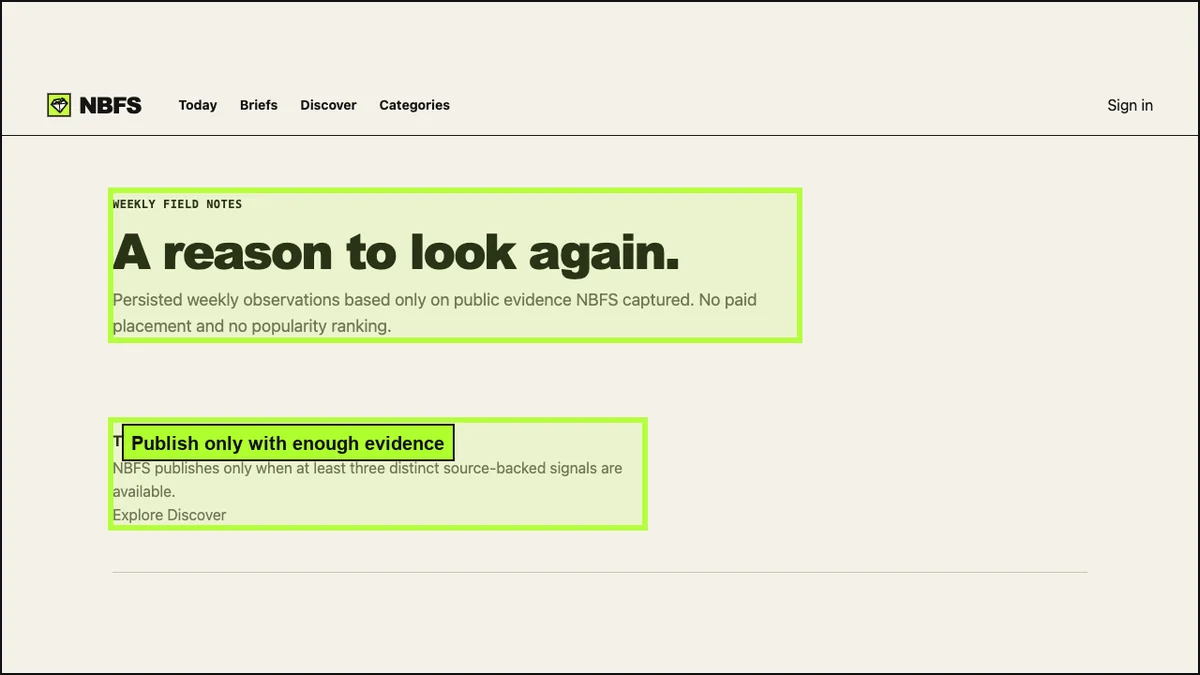
That empty state is part of the product philosophy. If there is not enough to say, do not publish filler. If the site is going to claim evidence-first discovery, the quiet days have to stay quiet.
What I want NBFS to become
I want NBFS to become a better second-pass discovery layer for Shopify merchants, developers, and operators.
For merchants, it should make it easier to find small apps that solve a real problem before those apps become obvious.
For developers, it should create a public surface where early apps are not erased just because the review count is still low.
For me, it is also a product experiment in structured discovery: how much value can come from public facts, transparent rules, and careful separation between source evidence and opinion?
The answer is not finished. The first version is live.
If you want to look below the rankings, start here: