
PopSmart Clerk was an AI store clerk for Shopify — a salesperson that lived on every page of a store, read what each shopper was doing, and said the one thing that might help them buy.
It shipped. It reached the Shopify App Store. I later took the listing private while I looked for a clearer merchant job.
Now the decision is cleaner: the original Clerk is dead. It belongs in the graveyard because demand did not show up clearly enough, and the product has fully pivoted.
What shipped
The first Clerk version tried to replace the blunt popup with an in-context assistant. Instead of blocking the shopper with a coupon, it watched product views, cart behavior, hesitation, exit intent, and other store signals, then generated a small product-aware nudge.
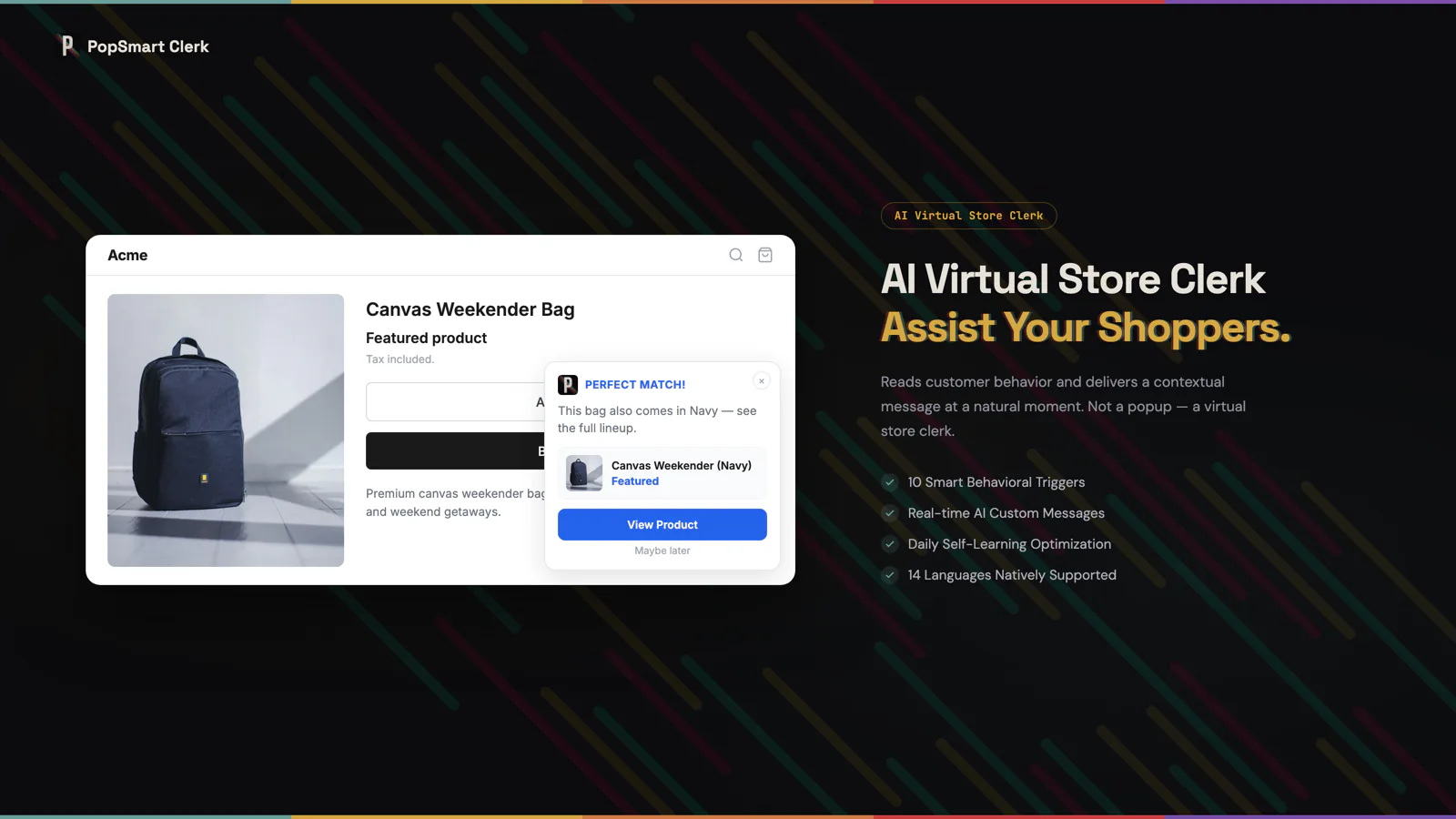
The first PopSmart Clerk version: an AI virtual store clerk that read shopper behavior and assisted in context.
The idea was not a chatbot. It did not wait for the shopper to ask a question. It was closer to a floor associate: quiet most of the time, useful when a specific moment appeared, and tied to the real product data in the store.
That shape still has things I like. Popups are crude. Generic recommendations are easy to ignore. A store that can speak from live catalog, discount, inventory, and behavior data is still an interesting product direction.
But interesting is not demand.
The signal was not strong enough
The uncomfortable part is that the product was not killed by a single technical failure.
It synced store data. It generated contextual lines. It had triggers, themes, avatars, cooldowns, and safeguards. It was a real app, not a landing page pretending to be one.
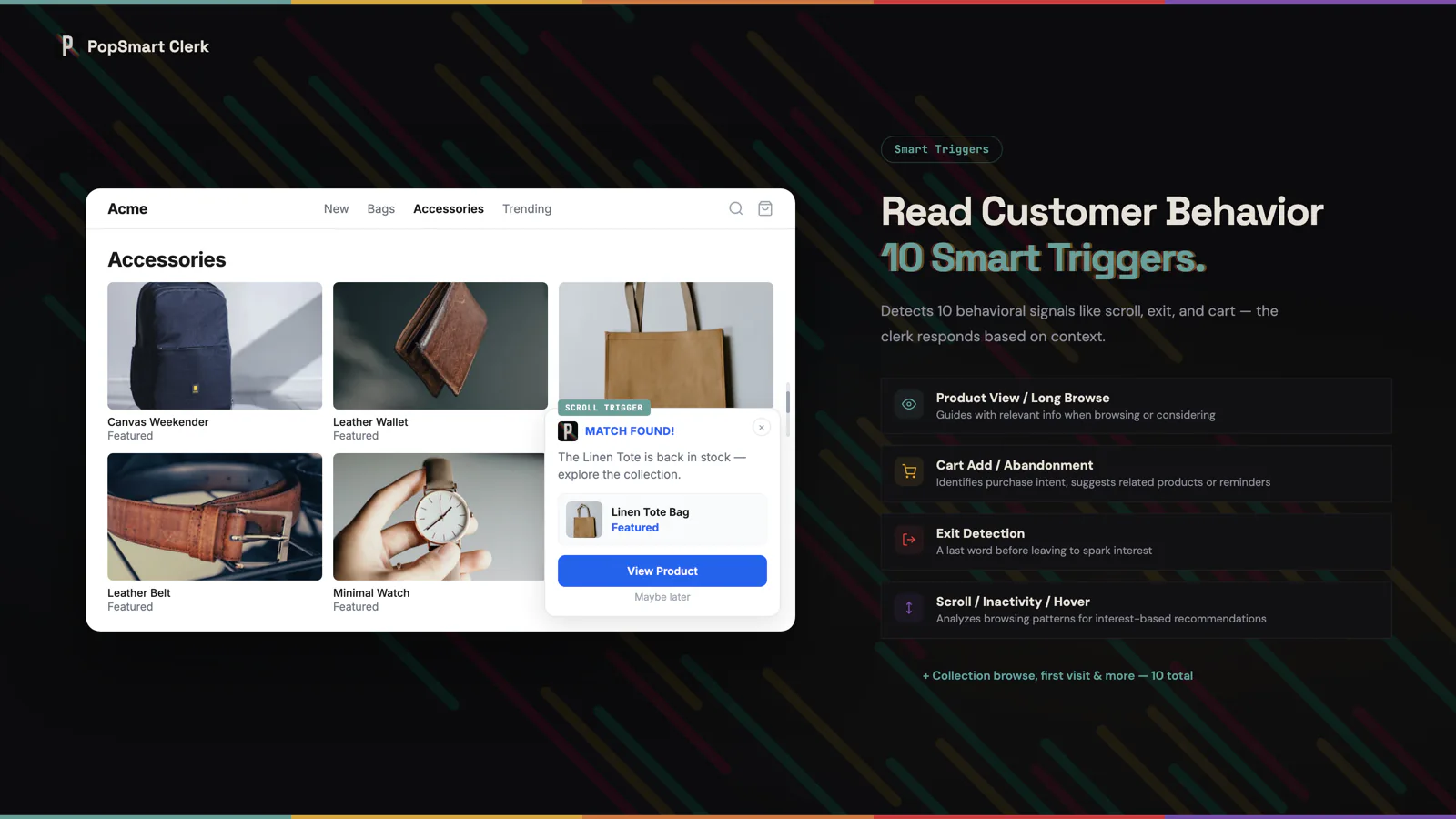
Ten triggers, each reading a different shopping moment and answering with a contextual message.
The problem was simpler: merchants did not pull for it hard enough.
A product can be coherent and still not be wanted. A feature can be clever and still not sit close enough to the buying decision. A Shopify app can be real and still fail to create the kind of repeated merchant behavior that justifies keeping the original shape alive.
That was Clerk.
Why it goes to the graveyard
For a while, I kept Clerk in a paused state because I knew the surface would change. That made sense during the pivot window.
It no longer makes sense now.
The original Clerk has fully pivoted. The next product will not be this exact AI store-clerk version with a private listing waiting in the background. Keeping it on the live shelf would be misleading. Live should mean the current bet still exists. Graveyard should mean the shipped version has been judged and closed.
So the old Clerk moves here.
The reason is blunt: clear demand was missing. Not vague interest. Not the fact that the product existed. Not the fact that the idea was defensible. Demand means repeated behavior from the right people. It means merchants pulling the product into their workflow without me having to protect the story.
That did not happen clearly enough.
What changes next
This is not the end of PopSmart. It is cleanup before the next public step.
I am preparing to announce two Shopify apps at the same time: one new app, and one pivoted app that came out of the Clerk work.
That is the cleaner move. The old Clerk record stays here, where the decision is visible. The new surfaces should stand on their own jobs, not inherit momentum from a product that did not earn enough demand.
The lesson is the same one the graveyard keeps teaching: do not confuse a shipped product with a validated product.
If demand is not clear, do not keep polishing the paused version. Move it to the graveyard, keep the useful parts, and make the next bet easier to judge.