
Needles.AI turned a prompt into a tattoo. Type a few words, sketch a rough shape, or hand it a photo, and a few seconds later you had finished flash — clean line work, traditional color, blackwork, whatever you asked for. It was free. I built all of it alone — the servers, the model, the site — and ran it for about a year before I shut it down, not because the output was bad, but because I had picked a fight I could not win.
What shipped
Needles.AI was a real, public product, not a demo. The front door was a wall of designs the model had already made; you scrolled it like a flash sheet and tapped anything to make your own version.
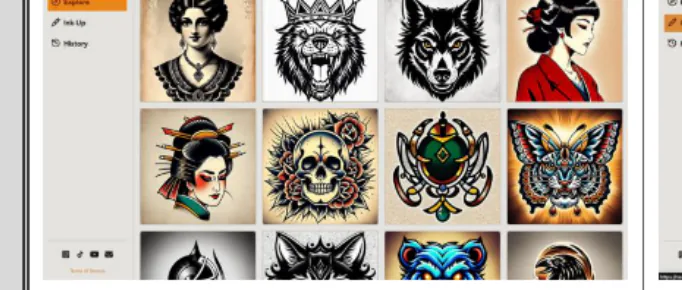
The front door — a gallery of generated designs you could scroll and remix.
There were three ways in. You could describe a tattoo in words. You could draw a rough sketch and let the model tighten it into clean line work. Or you could upload a photo — a face, a pet, an object — and get a stylized tattoo version back. Every result landed in a few seconds, and the basic generation was free.
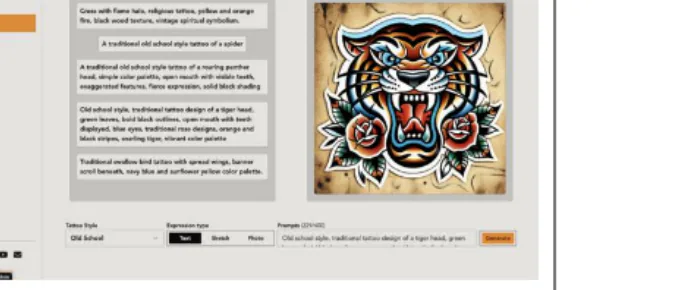
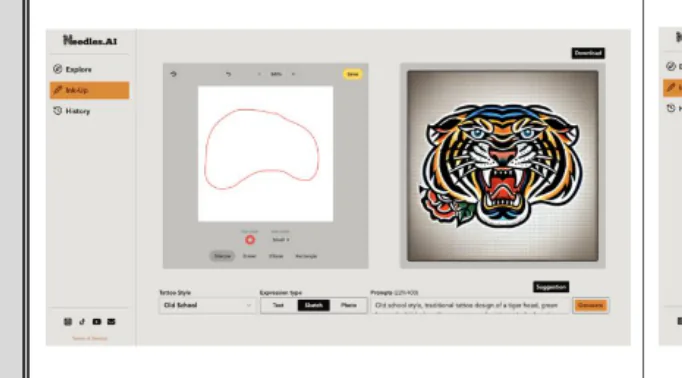
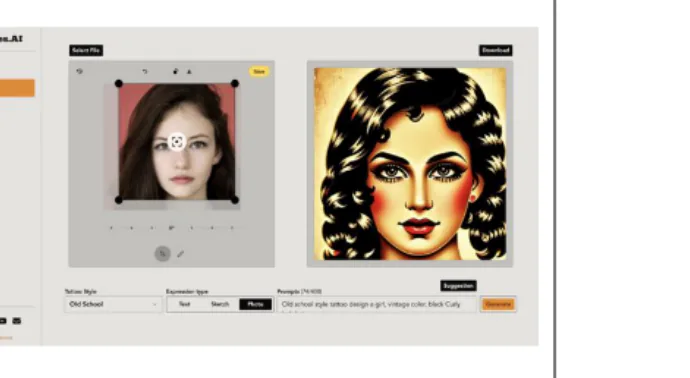
Three ways in: type it, sketch it, or photograph it. The model met you wherever you started.
Underneath, it was not an API call to someone else’s model. I collected the tattoo imagery, trained a checkpoint specialized for flash, and served the inference off GPUs I owned — bought secondhand out of a wound-down mining farm and bolted into servers I assembled myself from used parts. Hardware to software, it was A to Z mine: the racks, the cards, the training pipeline, the backend, the front end. The business meant to sit on top was ordinary commerce — turn the designs people liked into stickers and shirts. That part barely got started.
The model was the easy part
Here is the uncomfortable thing: the output was good. The model did American traditional, blackwork, lettering, neo-traditional. It held line weight, it understood what a tattoo is supposed to look like, and most of these came out usable on the first or second try.






Real outputs, first or second try — traditional, greywork, blackwork. The generation was never the problem.
If quality had been the thing standing in my way, I would have known what to do about it. It wasn’t.
Why it died
Three things killed Needles.AI. Two of them were about money.
It never made any. Generation was free, the goods pipeline barely got off the ground, and “free AI image generator” turns out to be a great way to gather users and a terrible way to get paid by them.
It cost money just to exist — even though I had driven that cost about as low as one person can. Ex-mining cards, hand-built boxes, power I metered obsessively: serving was cheap. But cheap times a lot of free generations, with nothing coming back, is still a leak that only widens as you grow. Popularity was a cost, not a business.
The third reason is the one that actually settled it, and it was the one thing my scrappiness could not touch. I was competing on the model layer at the exact moment that layer turned into a capital game. When I started, one person with a few secondhand GPUs could fine-tune a checkpoint that was genuinely competitive. Then SDXL landed, and the next one, and the gap opened. You can buy inference cheap out of a mining farm; you cannot thrift your way to a training cluster that keeps pace with a company spending more on a single run than I spent on the whole company. Training a model that could keep up stopped being something my hardware could do — it now wanted a data center. I could keep the service running. I could not keep the model at the frontier, and on a product whose whole pitch is the model, those are the same thing on a delay.
What changed afterward
I shut it down in early 2025 and wrote the conclusion down plainly: this was not a thing one person could win. Not because I wasn’t good enough, but because the moat had moved to a resource I was never going to own — raw compute. The model layer had quietly become big tech’s home field.
The rule I took from it: don’t build where your competitor’s advantage is capital you can’t match. Build on top of the frontier models, not against them. Let the people burning billions on training carry that cost, and put your own work in the layer they do not care about — the product, the taste, the specific audience, the thing that is annoying to do well and cheap to run.
It is 2026 now, and the gap between a solo builder’s model and the frontier is wider than it was the day I quit. The call was right. Needles.AI made genuinely good tattoos and lost anyway — because I had staked it on the one fight where effort does not beat a budget.
There is one more thing I keep about it. Needles.AI was the last project I ever wrote entirely by hand — every line mine, no AI in the loop. The next thing I built, I had one helping, and I never went back to the old way. I shipped an AI product as the last work of my pre-AI self, and did not see the line until I was already on the far side of it.