
MeAri was the first product I ever shipped. I built it in 2015, while I was still a university student — no team, no budget, writing it between classes. It was an anonymous social app built on one borrowed idea, doubled: a Twitter-style public feed crossed with Snapchat’s disappearing posts. Every post — text, photo, video, or a recorded voice clip — arrived with a countdown, and the countdown was alive: a like bought the post more time, a dislike took time away. The name is 메아리, Korean for “echo”: you called something into the feed, and how long it echoed was up to everyone else. The posts people liked rang on; the ones they did not collapsed early. When the timer finally hit zero, the post was gone.
It shipped, it found about 2,000 people, and it died of the exact mechanic that was supposed to make it interesting.
What shipped
This was a finished app on Android, not a prototype. You could post four ways — video, text, photo, or a recorded voice clip — and every one of them dropped into the feed with a countdown already running. The feed had three modes: new, popular, and random, so you could read the freshest posts, the ones collecting reactions, or gamble on something at random. You could react to a post, mute it, “echo” it (the repost), or blind anything you did not want to see. Posts carried hashtags.
That vote-driven clock was the whole design idea, not a gimmick. The feed was supposed to curate itself: the posts a crowd liked would live long enough to find an audience, the ones it downvoted would die faster, and quality would sort itself out without anyone having to police it. Survival was a popularity contest with a stopwatch.


One feed, four kinds of post — video, text, photo, and a held-button voice clip — each dropped in with a countdown already running.
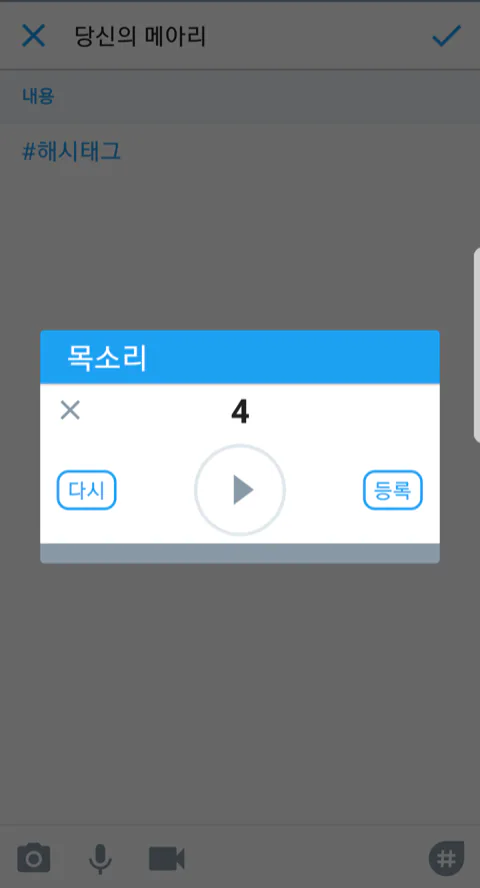
The part I was proudest of was voice. You could hold a button, record a few seconds, and drop your actual voice into an anonymous feed. Anonymous, but with a real human sound to it. The countdown sat on every post, usually under an hour, and when it hit zero the post collapsed into a gray placeholder: this echo has disappeared.

The voice recorder. Hold the button, record a few seconds of your actual voice, and drop it into an anonymous feed.
It was small, but it was a complete loop: open, post, react, watch it fade.
What happened
The first weeks were the app talking to itself. A few people posted, a few reacted, and the timers only ever counted down — there was never enough of a crowd to vote anything more life. The feed never filled up, because the moment something good appeared, the clock was already eating it. By the time a new user installed, browsed, and decided whether to post, the posts they had seen advertised were already gone. The “new” tab was often a short list. The “popular” tab needed reactions, which needed users, which were not there yet.
About 2,000 downloads sounds like a start. But they did not all arrive at once — they trickled in across the four months it was live. Ephemerality punishes a trickle.
Why it died
The disappearing mechanic was the whole pitch, and the rule layered on top of it was the whole trap. A post only earned more time if people liked it — but likes need people, and people are exactly what a new app does not have. So nothing ever earned its extension. Every post just bled out the minimum clock and vanished, the good and the bad at the same rate, because the votes that were supposed to tell them apart never came. The system I built to let the crowd keep the best posts alive had no crowd, so it kept nothing alive. Ephemeral social only works at density: Snapchat’s posts can vanish because there is always another a second behind and another hand to lift it. MeAri had neither. Content decayed faster than users arrived, the curation never fired, and the feature that made the idea sound new — “real anonymous SNS, nothing sticks around” — was the feature fighting the cold start.

The shape of the problem: a post that already expired, and a timer eating the next one — with no votes coming in to buy it more time.
Underneath that was a simpler mistake. I confused a novel mechanic with a reason to come back. Disappearing posts are a great retention amplifier once a crowd exists. They are a terrible acquisition tool when one does not. I shipped the amplifier without the crowd, then watched it amplify an empty room.
There was a second way it died, quieter but just as fatal. Anonymous plus disappearing is a magnet for exactly what you do not want: porn and scam posts showed up, and every tool I had — report, mute, blind — was after-the-fact. A post could do its damage and expire before I ever saw the flag. Ephemerality protected the abusers too: by the time anything was reported, the evidence had already deleted itself. I never built real moderation, and on an anonymous feed that is not a missing feature — it is an open door.


Everything I had against abuse was reactive: blind a post, mute a user, and hope the timer got there first. On an anonymous feed, that is not moderation — it is an open door.
What changed afterward
MeAri is where I learned that some features are scaling features, not launch features. Letting likes extend a post’s life was the clearest example: it sounds like smart curation, but it assumes a crowd, and in an empty room it just kills everything at the floor — the good posts and the bad ones identically, because no one is there to tell them apart.
The rules I took from it, and have used on every launch since:
- Do not ship a core mechanic that fights your own cold start.
- Do not outsource survival to a crowd you do not have yet. If a post needs votes to live, an empty room kills all of them at the floor.
- If the product needs a crowd to feel alive, get the crowd first, then add the disappearing act.
- “Interesting” is not “repeatable.” A clever loop is worth nothing until something pulls the same person back tomorrow.
- Anonymity is a feature with a tax. If you cannot afford to moderate it, you cannot afford to ship it.
It was the first thing I built — a student project that shipped for real — so it taught the most expensive lessons cheaply: about 2,000 downloads, one dead feed, and a short list of rules that have saved every product after it. The echo faded. The lessons did not.