
AIWAR was a live board for reading the AI race from the outside. It used the public U.S.–China AI competition as a frame, then kept the claim narrower than a scoreboard: labeled signals, evidence cards, user calls, and a rule-based editorial impact index showing where the front appeared to be moving.
It shipped. It was public. It had a real product surface. And now it belongs in the graveyard.
The reason is simple: there was no normal user demand.
What shipped
AIWAR was built as a command board, not a benchmark. A leaderboard would have been cleaner, but it would have flattened the question. A feed would have been current, but hard to read. AIWAR sat between those two shapes.
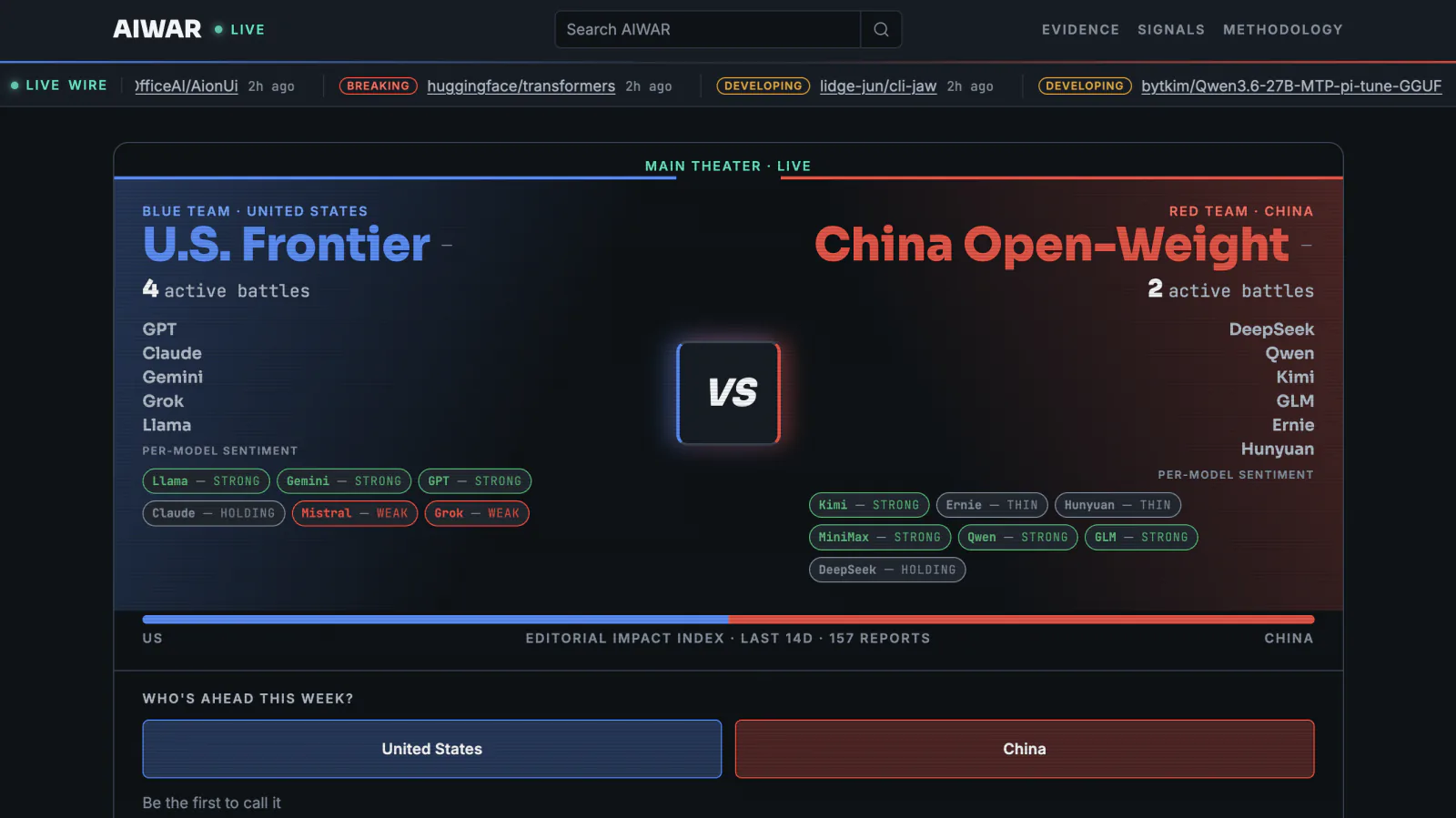
The main theater: U.S. Frontier against China Open-Weight, with live signals, model sentiment, and active battles.
The home view opened with AIWAR · LIVE, a search box, and three plain sections: Evidence, Signals, and Methodology. A Live Wire ticker pulled public movement into the surface. The center of the page framed the board as U.S. Frontier on one side and China Open-Weight on the other.
The product listed familiar model families — GPT, Claude, Gemini, Grok, Llama, DeepSeek, Qwen, Kimi, GLM, Ernie, Hunyuan — but it did not pretend one universal number could settle the whole question.
The honest part was the index
The most important line on the page was small: editorial index, not a benchmark.
AIWAR’s Faction Impact Index was a rule-based editorial score over a recent window. Higher meant gaining ground inside this site’s labeled evidence set. It did not mean a model was objectively better. It did not mean one country had won. It meant the board had seen more or stronger movement in that direction under the published rules.
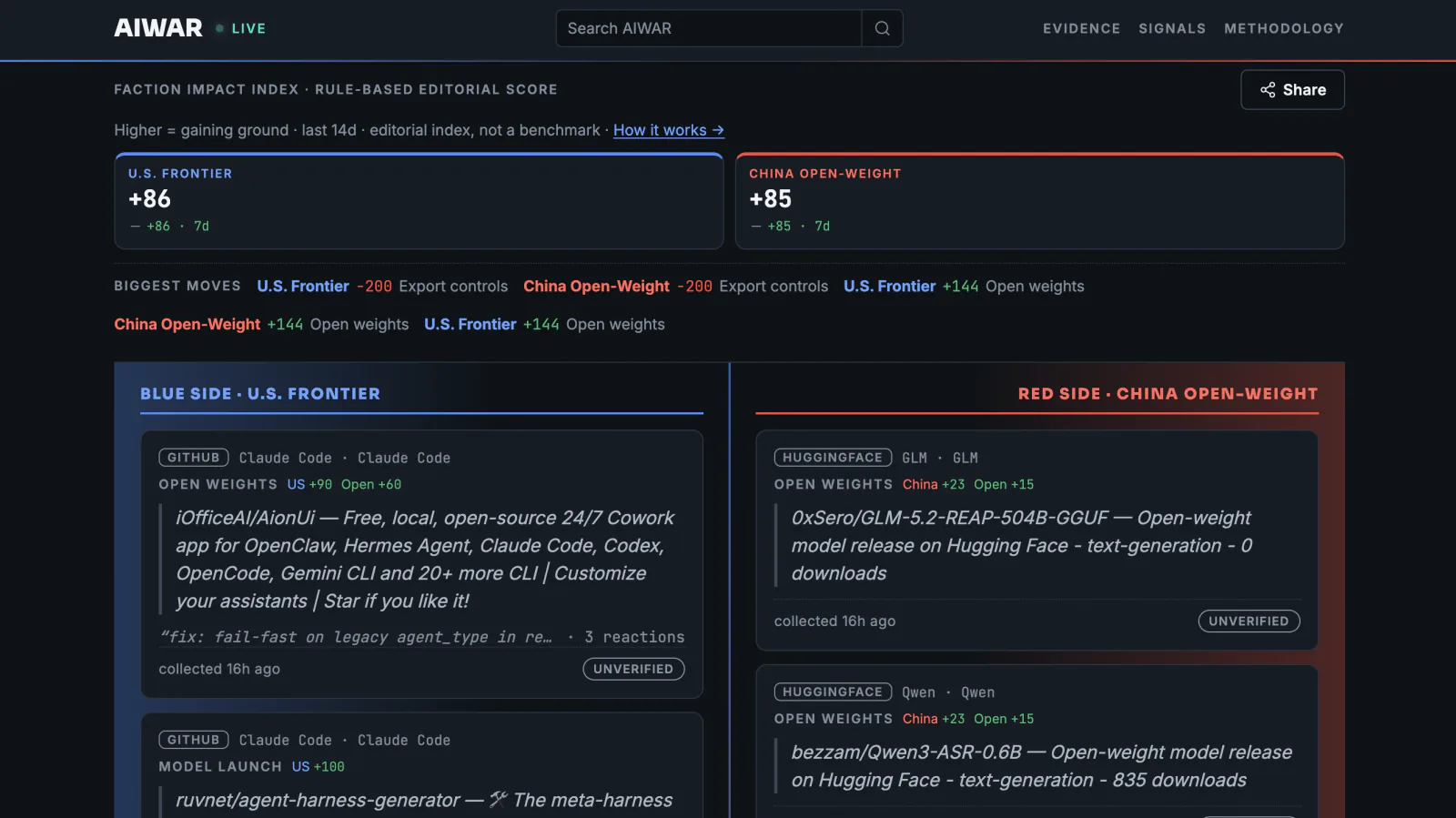
The impact board kept the numbers explainable: event type, side, confidence, recency, and movement reason.
That distinction was the part I still like. Export controls, open-weight releases, price cuts, outages, migrations, adoption signals, and disputed benchmarks can all matter. They just should not be laundered into fake certainty.
What happened
For roughly three months, AIWAR mostly received bot requests.
That is not the same as usage. Bots can make dashboards look alive. They can create logs, bandwidth, and error surfaces. They can make a product feel operationally real while the audience is absent.
But ordinary users did not show up in a way that justified keeping the service alive. There was no repeated behavior worth protecting. No clear reader habit. No sign that the board had become a thing people needed to check.
The contrast came from NBFS.
NBFS is a much narrower surface: an evidence-first discovery board for Shopify apps that are not Built for Shopify. In two weeks, it passed the traffic AIWAR had collected across its three-month run.
That does not make NBFS a guaranteed win. It just makes the next decision obvious.
Why it died
AIWAR died because demand did not arrive.
The product had a strong frame, but not enough pull. The AI race is loud. The product tried to make that noise legible. But a loud subject is not the same as a needed product. A person can care about the U.S.–China AI race and still not need a board from me to read it.
That was the mistake: I treated a compelling frame like a distribution advantage. It was not one.
There is also an operating cost to this kind of product. A signal board only stays honest if it is maintained. Sources need to be checked. Labels need to stay strict. Methodology needs to remain readable. The index can only move when the evidence moves. If no real audience is forming around that work, the right call is not to keep polishing the board for bots.
What changes now
AIWAR is being shut down and moved from Live to the Graveyard.
The resources move to NBFS. That is where the stronger signal is. It has a clearer audience, a narrower job, and more real traffic in its first two weeks than AIWAR produced in three months.
The lesson is blunt: bots are not demand. Interesting framing is not demand. A public URL is not demand.
Demand is repeated human behavior. If it does not show up, kill the product cleanly and move the attention to the place where it did.